
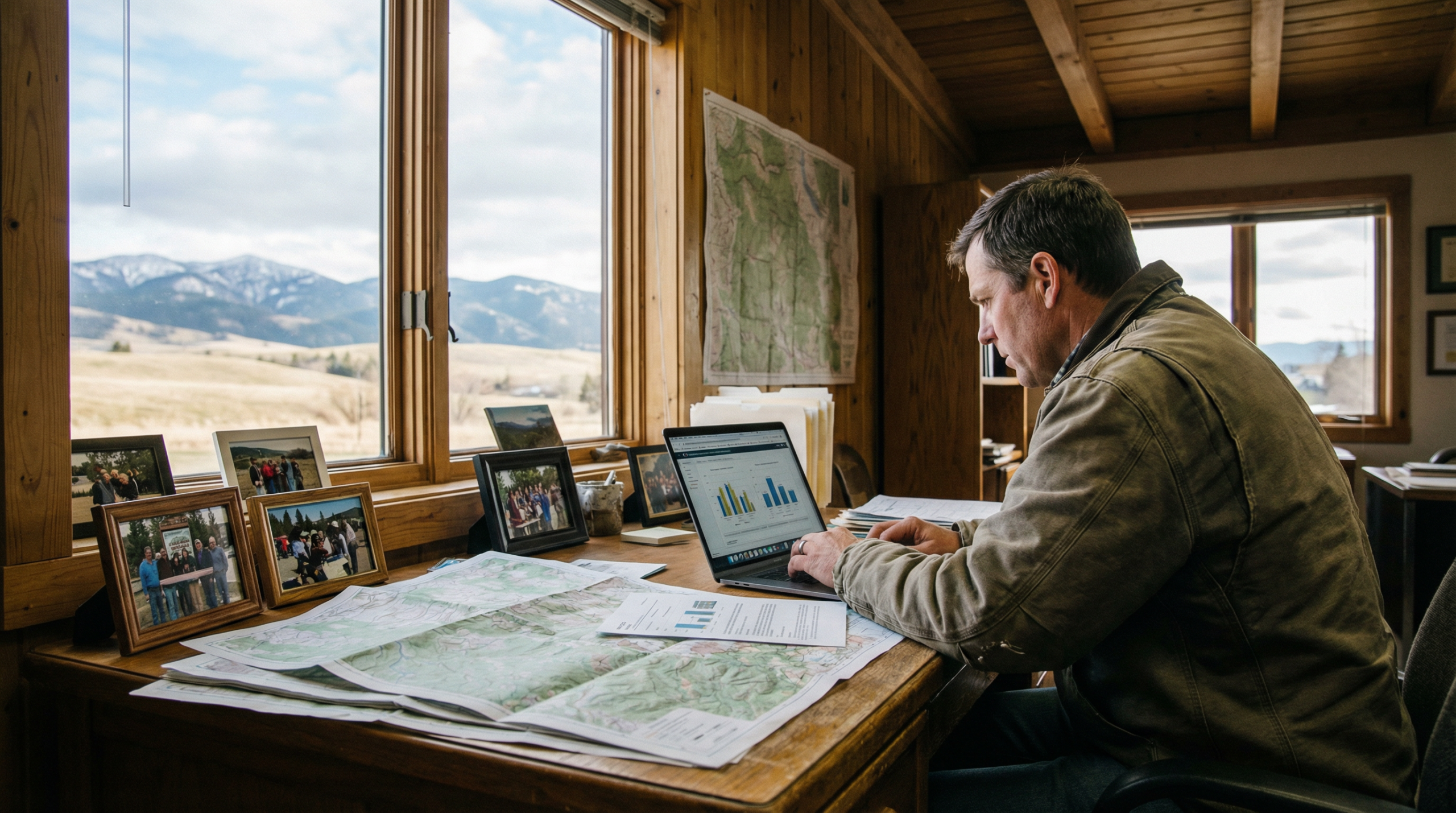
Montana local SEO in 2026 operates differently from urban markets due to its low population density of just 7.4 people per square mile. The unique landscape offers less competition, highly localized search intent, and communities that prefer businesses rooted in their region. For businesses looking to harness the power of local SEO Montana, understanding these dynamics is crucial.
Montana’s distinctiveness stems from its geographic spread. Each city, from Billings to Missoula and Bozeman to Great Falls, functions as a micro-market with unique search patterns, seasonal demand spikes, and industry concentrations like agriculture, tourism, tech, and healthcare.
“Montana’s geographic spread creates micro-markets where businesses must tailor strategies to unique local search patterns and industry demands.”
Businesses partnering with local growth experts realize that blanket tactics are ineffective here. Strategies successful in urban centers like Chicago often fail in cities like Helena.
For any Montana business, the most impactful starting point is optimizing the Google Business Profile — a crucial but often underutilized visibility tool.
Advanced Google Business Profile Optimization for Montana Local SEO
Google Business Profile (GBP) is the most powerful tool for capturing intent-driven local searches in Montana’s dispersed geography, where “near me” queries dominate rural corridors.
A well-optimized Google Business Profile not only boosts visibility but also acts as an independent landing page for potential customers.
Key optimization priorities for 2026 include:
- Category precision — Choose categories that accurately reflect services rather than aspirational ones.
- Service area configuration — Essential for businesses serving multiple Montana counties without a physical presence in each.
- Photo cadence — Consistent, geotagged images signal active management to Google’s local ranking systems.
- Q&A management — Populate this section proactively, as AI-powered search increasingly utilizes structured GBP data.
According to Local SEO 2026 guidance, review velocity and recency significantly impact local pack rankings. Encouraging timely, detailed customer reviews and prompt responses is crucial in competitive Montana markets.
Agencies like Young10 Marketing use GBP optimization as a foundational strategy, recognizing that profile completeness directly affects local content performance, leading to questions about what resonates with Montana audiences.
Hyper-Local Content Strategies for 2026: Boosting Local SEO Montana
Creating content that deeply resonates with Montana’s geographically dispersed communities is crucial. Generic content fails to engage audiences in Billings, Bozeman, and Butte, each with distinct identities, seasonal priorities, and search behaviors.
Effective SEO services in Montana recognize that hyper-local content involves more than city-name stuffing. It involves providing genuinely useful material tied to local events, regional landmarks, seasonal conditions, and community-specific concerns. For instance, a roofing company might create content on hail damage specific to the Beartooth Highway corridor rather than broad national weather guides.
Neighborhood-level content not only outperforms generic regional pages but also enhances local presence to search engines and potential customers.
Building dedicated location pages for each primary service area, enriched with locally relevant context, is a practical approach. According to ALM Corp’s local SEO guidance, granular localization signals are increasingly influential in AI-assisted search, making this content investment worthwhile for 2026 and beyond.
These localized assets naturally establish the credibility signals demanded by the E-E-A-T framework.
Building Trust with E-E-A-T Signals
Effective SEO strategies in Montana go beyond technical optimization to demonstrate genuine authority and trustworthiness to search engines and potential customers. Google’s E-E-A-T framework (Experience, Expertise, Authoritativeness, and Trustworthiness) is increasingly decisive in determining which local businesses appear prominently in competitive searches.
Trustworthiness in SEO is the cumulative weight of consistent, verifiable actions across all digital touchpoints.
Montana businesses build E-E-A-T through interconnected approaches:
- Local credentials and affiliations — Membership in Montana Chamber of Commerce chapters or industry associations signals community legitimacy.
- Customer reviews — Consistent, detailed reviews across Google, industry directories, and local platforms reinforce authentic experience.
- Author expertise — Content attributed to named local professionals carries greater authority than anonymous copy.
Ensuring every piece of content links to verifiable business information, physical addresses, and professional credentials is practical. According to the Local SEO 2026 Complete Guide, businesses systematically building these trust layers see stronger sustained rankings over time.
As these signals compound, the tools used to manage and scale them become critical, and AI-driven solutions are reshaping possibilities.
Leveraging AI for Local SEO Success in Montana
Artificial intelligence is transforming local SEO strategies in Montana. Understanding this shift is a competitive necessity for 2026.
AI-powered search features increasingly deliver results based on conversational intent rather than keyword matching alone. For Montana businesses, this means structuring content around natural questions: “Where can I find a reliable plumber in Missoula?” rather than generic keyword stuffing. Tools analyzing local search intent can efficiently identify these patterns.
Structured, intent-driven content distinguishes visible Montana businesses from those obscured in AI-curated search results.
Using AI to audit existing content for gaps in local relevance is a practical approach, identifying which service pages lack geographic context or hyper-local references. Agencies like Young10 Marketing help Montana businesses apply these AI-driven insights strategically while maintaining an authentic local voice.
AI is a tool, not a replacement for human expertise. Knowing which metrics to monitor ensures efforts translate into measurable growth, a topic explored in detail in the next section.
Technical Deep Dive: Local SEO Metrics to Track
Identifying the metrics that genuinely impact success differentiates high-performing SEO campaigns for Montana businesses from ineffective ones. Without clear measurement, even well-structured strategies become guesswork.
The metrics worth consistently monitoring include:
- Google Business Profile views and actions — Clicks to call, direction requests, and website visits signal genuine local intent.
- Local pack ranking position — Track your appearance across key Montana towns and search queries.
- Organic click-through rate (CTR) — Indicates whether your title tags and meta descriptions resonate locally.
- Review velocity and average rating — Influence both ranking and conversion simultaneously.
Consistent tracking of local conversion actions — not just rankings — reveals the true commercial value of your SEO investment.
Establishing monthly reporting benchmarks early is practical, so performance trends become visible before problems compound. According to the Local SEO 2026 Complete Guide, citation consistency and GBP engagement are among the most influential ranking factors this year.
However, data alone won’t guarantee results, and many businesses stumble into common misconceptions worth addressing.
Common Misconceptions About Local SEO
Montana businesses investing in digital visibility must clear up persistent myths to make meaningful progress.
Myth 1: Local SEO is a one-time task. In reality, algorithm updates, competitor activity, and shifting consumer behavior mean that local rankings require ongoing maintenance.
Myth 2: Technical SEO is irrelevant at the local level. This is incorrect. Page speed, structured data, and mobile optimization directly influence how search engines present local results.
Myth 3: More keywords mean better rankings. Keyword stuffing dilutes relevance rather than strengthening it.
Consistent, accurate information across every digital touchpoint is the most reliable driver of sustainable local search performance.
Understanding local SEO’s limitations is as crucial as understanding its potential, especially as the landscape evolves toward 2026.
Future Implications: What’s Next for Local SEO in Montana?
Looking forward, the local search landscape in 2026 rewards those who prepare early.
Google Business Profile optimization remains central to local visibility, but its role is evolving. AI-driven search results now incorporate GBP data into conversational responses, meaning poorly maintained profiles risk disappearing from AI-generated answers entirely.
A common pattern emerging in competitive local markets is the growing importance of hyper-local content signals: reviews mentioning specific neighborhoods, actively managed Q&A sections, and regularly updated photo libraries. Montana’s dispersed geography makes this particularly relevant.
“Businesses that treat their Google Business Profile as a living document consistently outpace those that don’t.”
Agencies like Young10 Marketing help Montana clients adapt to these shifts through structured profile management and AI-ready content frameworks. Businesses investing now will transition more smoothly.
Key takeaways ahead will consolidate these strategic priorities into actionable steps.
Key Montana Local SEO Takeaways
As Montana’s digital landscape accelerates toward 2026, businesses that outperform competitors treat local SEO as an ongoing strategic investment rather than a one-time task.
Several patterns emerge clearly:
- Google Business Profile optimization remains the single highest-impact action for Montana businesses.
- Hyperlocal content rooted in genuine community knowledge consistently outperforms generic regional copy.
- Voice and AI-driven search reshape how Montana consumers discover local services, demanding conversational, intent-focused language.
- Mobile-first experiences are essential, especially given Montana’s vast rural coverage areas.
- Reviews and reputation management influence both rankings and consumer trust.
A critical principle holds firm: Consistency across citations, content, and customer engagement compounds over time. Shortcuts rarely survive algorithm updates.
Agencies like Young10 Marketing understand that Montana’s unique geography and community character require tailored approaches, not generic templates from national campaigns.
With fundamentals solidly in place, the question naturally shifts to how the broader SEO discipline is evolving — and what the wider landscape looks like heading into 2026.
What is the Evolution of SEO in 2026?
The broader SEO landscape has shifted dramatically, and Montana businesses must treat search optimization as an evolving discipline. What worked in 2022 — keyword stuffing, directory spam, and generic content — now harms rankings.
Several defining shifts characterize SEO in 2026:
- AI-generated search summaries answer many queries before users click any result.
- Conversational and voice search make natural language optimization non-negotiable.
- Hyper-local intent signals carry greater algorithmic weight than broad keyword volume.
- Engagement metrics like dwell time, interaction rates, and return visits increasingly influence rankings.
Relevance has replaced volume as the primary currency of search — businesses that answer specific questions for specific communities win.
Montana businesses that consistently publish authoritative, locally-grounded content gain visibility advantages over competitors relying on outdated tactics. According to ALM Corp’s guide, user experience signals are now deeply integrated into local ranking algorithms.
Understanding this evolution raises a question: given rapid changes, how long should Montana businesses expect before strategies produce results?
How Long Does SEO Take to Show Results in 2026?
Timeline expectations are a common point of confusion for Montana business owners investing in local SEO. The answer is nuanced; agencies promising overnight rankings should provoke skepticism.
Most local SEO campaigns begin showing measurable movement within three to six months, with competitive markets potentially requiring nine to twelve months for significant ranking gains. In 2026, AI-driven search features can surface well-optimized local businesses faster once core signals align correctly.
Factors influencing your timeline include:
- Current baseline — An established domain with existing authority moves faster.
- Competition density — Billings and Missoula are more contested than rural areas.
- Content consistency — Regular, relevant updates accelerate trust signals.
“SEO is not a campaign with an end date; it’s an infrastructure investment that compounds in value the longer it’s maintained.”
Acknowledging this reality shapes smarter budgeting decisions. Rather than chasing quick wins, Montana businesses achieve sustainable growth by committing to incremental improvements month over month — a strategy that informs how high-ranking local results are built and maintained.
What Are Some Strategies for Achieving a High Ranking on Local Search in Montana?
With a clear understanding of timelines and the evolving SEO landscape, the practical question becomes: what strategies consistently move the needle for Montana businesses?
Google Business Profile optimization is the highest-impact action. Businesses maintaining complete, regularly updated profiles outperform inactive competitors measurably.
Beyond GBP, a focused approach should include:
- Localized content targeting Montana-specific queries and community language.
- Citation consistency across directories, ensuring NAP (name, address, phone) uniformity.
- Review generation through systematic, ethical customer follow-up.
- Mobile-first technical performance, considering Montana’s rural browsing habits.
According to ALM Corp’s local SEO guidance, structured data markup is increasingly critical for visibility in AI-generated search results.
Agencies like Young10 Marketing integrate these tactics into cohesive campaigns rather than isolated fixes, as fragmented efforts rarely result in sustainable rankings.
The strategies above reflect what’s known today, but 2026 has introduced several shifts not anticipated a year ago.
What Are the SEO Changes in 2026 That Weren’t Seen in 2025?
The SEO landscape has shifted in ways even experienced digital marketers didn’t fully anticipate. For Montana businesses, understanding these emerging changes is essential for staying competitive.
Several developments stand out:
- AI-generated search summaries now occupy prime screen real estate, pushing traditional organic results down.
- Hyper-local intent signals are more sophisticated, distinguishing between Billings and Bozeman audiences with precision.
- Visual and voice search convergence means optimizing for images and spoken queries is essential.
- Zero-click searches have accelerated, making structured data and schema markup critical for visibility.
Brand authority signals now carry disproportionate weight compared to link volume alone. According to the Complete Guide to Dominating Local Search, entities — not just keywords — increasingly determine ranking outcomes.
Authenticity and consistent entity signals across platforms now define modern SEO success, outperforming outdated tactics.
At Young10 Marketing, this shift reinforces a content-first, brand-centric philosophy for Montana clients. These changes raise a broader question many marketers are grappling with — is SEO still relevant, or has it fundamentally transformed?
Is SEO Really Dead in 2026, or Are Marketers Just Using It Wrong?
The “SEO is dead” narrative resurfaces annually, yet Montana businesses committing to structured, location-specific optimization continue to gain measurable ground. The truth is straightforward: SEO has evolved, not expired.
What’s dead is the outdated playbook — keyword stuffing, generic content, and ignoring AI-driven search behavior. What’s thriving is intent-driven, hyper-local strategy tailored to how real customers in Billings, Missoula, or Bozeman search.
Sustainable local visibility is about demonstrating relevance, authority, and trustworthiness to both search engines and your community.
As covered throughout this guide, local SEO in Montana in 2026 demands a multi-layered approach: optimized Google Business Profiles, voice search readiness, AI-adapted content, and genuine community signals. Agencies like Young10 Marketing understand that local markets require localized thinking, not one-size-fits-all tactics.
The Complete Guide to Dominating Local Search reinforces that businesses committed to consistent, quality optimization outperform competitors treating SEO as optional. Start auditing your local presence today — Montana’s digital landscape rewards decisive action.